
Set up their device from yours
You create your child’s account from your own phone and it is signed with your key. A child cannot complete a sign-up alone, and there is no “I am an adult” box a child can tick.



Chat. Call. Be Close.
On the App Store and Google Play
Calls and messages between your child and the people you choose. Friends, grandparents, you. On an old phone with no SIM, over Wi-Fi. Nobody can look your child up, because there is nothing to look them up in.

Rilo has no directory and no username lookup. A contact starts with a one-time invite from a grown-up, scanned from another phone’s screen or sent as a link that expires within the hour.
Every contact involving a child only exists once a grown-up says yes on their own phone, with their own fingerprint or face.
Calls and messages are scrambled so only the two phones involved can unscramble them. The phones know which key belongs to which person, so nobody can slip in between. Including us.
No advertising, no analytics, and nothing from anybody else running inside the apps or on this page.
How it works
You create your child’s account from your own phone and it is signed with your key. A child cannot complete a sign-up alone, and there is no “I am an adult” box a child can tick.
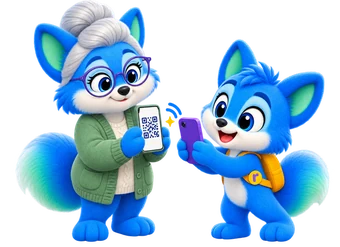
Grandma’s phone shows a code that works once. Your phone scans it. That is also the moment the two phones learn to recognise each other for good, which is what keeps everybody else out of the call later.

No contact exists until a grown-up says yes. Two children need a grown-up on each side. Any of them can cut a contact later, and it stops working straight away, even mid-call.
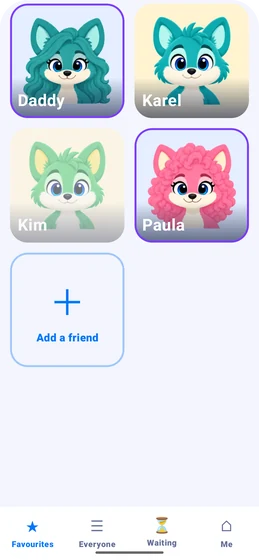
Everyone your child is allowed to reach, as big photo tiles. Nothing to type, nowhere to get lost. A child who cannot read yet can use this, because there is nothing on it to read.
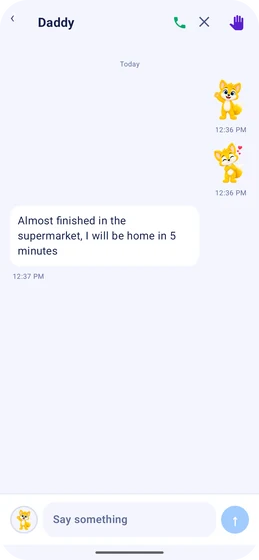
Photographs, video and links are not part of it at all. A child who cannot spell yet sends a fox. One who can, types. Every message is scrambled so only the two phones can read it.
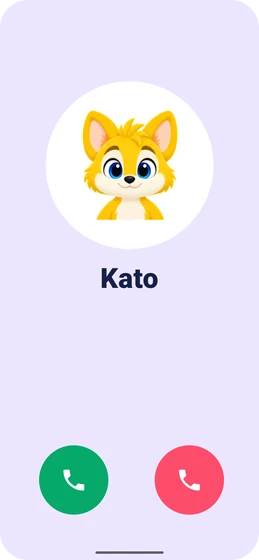
Green to answer, red to not. That is the entire decision. Nobody who has not been approved by a grown-up on both sides can ever make this screen appear.

One screen, with your child’s face on it and a green button when it rings. You send the invite and say yes once.

Two families, two yeses. A grown-up on each side has to approve the other child by name before anything happens at all. The same rule that lets your child ring Grandma, doubled.

No SIM, no monthly bill. An old phone or a shared tablet over Wi-Fi is enough. The one your child rings when you are at work, at the shop, or just running late.
How it works for a grandparent Or compare it with a watch, an old phone, or waiting
What we keep
Set on your phones, passed straight to the other phone. They never reach us.
Who your child may call is decided on your phone and stays on the two phones involved.
Locked between the two phones. A message waiting for a phone that is off sits here as a sealed box.
Waiting for you
Sam would like to talk to Emma.
If you approve, Sam and Emma can call and message each other, without you present.
Sam’s grown-up has already said yes on their side.
I know who this is and I am choosing to allow it.
Approvals
Every person your child talks to arrives on this screen first. A friend from school, a cousin, their grandmother. Both buttons weigh the same, Approve waits five seconds and needs a tick, and the sentence in the middle says exactly what you are agreeing to.
Money
By the families who set it up, through the App Store or Google Play.
One child costs €1 a month or €10 a year. Up to six children cost €2 a month or €20 a year. Where the euro is not the currency, the store shows the price in yours.
Setting up your first child starts with a free period. One subscription covers both parents’ phones, and nobody your child calls is ever asked for anything. Sold in the EU only.
It also does not need a new device. An old phone with no SIM card works, because everything runs over Wi-Fi. A real saving next to a kids’ smartwatch or a SIM-only plan bought just for a child.
Questions
Roughly four to ten. The child’s side is built for someone who cannot read yet. Large photo tiles, navigation by face, no menus, and the little text there is decorates rather than instructs. The grown-up side is an ordinary app for you.
Reaching your child takes two things at once: an invite that came from a grown-up, and a yes from a grown-up you had already trusted with that account, given on their own phone. There is nothing to guess, nothing to search, and no list of children anywhere to leak. An invite forwarded to somebody else connects them to nobody. It can only put a name in front of you that you did not expect, and you decline it. Even somebody who stole everything we have could not create a single contact, because we hold nothing capable of granting one.
No. A shared family tablet works, and each child gets a profile they pick by tapping their own photo. An old phone with no SIM works too, because everything runs over Wi-Fi.
No, and neither can we. You decide something bigger than that, which is who your child can talk to at all, and whether each contact is calls, messages, or both. At this age that is the part that actually protects them. The messages themselves are scrambled so only the two phones can open them, and that wall has no side door, not for us and not for a parent. If you want to read along, do it the old way and sit down together with the phone.
Now, on both. Rilo is on the App Store for iPhone and iPad, and on Google Play for Android.